Industrial Design Proposal
Belt Clip: A Mechanism That Disappears
Prepared by: Amat Studios
September 23, 2026
Valid for: 30 days
Prepared exclusively for David Monzon. A structured path from concept to a production-ready belt clip mechanism, validated in your hands before it's finalized.
Executive summary
Small part, real engineering

( 01 )
A belt tail that flaps or sticks out past the keeper loop is a small detail that reads as sloppy. Solving it well means a clip that adjusts to different belt widths, locks without hardware showing, and stays nearly invisible when facing the wearer. That last constraint drives every decision in the mechanism, not just the finish. This is a mechanical design problem before it's an aesthetic one.
( 02 )
This proposal covers the full path from sizing research through a validated mechanism prototype to a production-ready design. You test the mechanism in hand before we move on to how it looks.
Challenge / Opportunity
Getting small right is harder than getting big right
( Challenge 01 )
Belt widths vary
Belts run from 1.25" to 1.75" wide depending on brand and style. A clip sized for one width won't fit the rest, so the mechanism has to adapt without feeling loose or fiddly.
( Challenge 02 )
Invisible is the hard requirement
No glue, no magnets, and almost nothing visible from the front. That rules out easy mechanical solutions and forces a tighter, more deliberate design.
( Challenge 03 )
It has to survive daily use
A clip that loosens over time, scratches the belt, or is awkward to put on defeats the purpose. The jaw geometry and spring behavior need to hold up to repeated use.
The Opportunity
A mechanism you can hold before you commit to it
Rather than jumping straight to a finished-looking render, this process proves the mechanism physically first. You get a working prototype in hand, confirm it grips and adjusts the way it should, and only then do we move to final aesthetics and production prep.
Proposed solution
From sizing research to a prototype you can test

( 01 )
We start with the belt itself. A short sizing and thickness study across common belt widths settles whether the clip should be a single adjustable body or sized variants, before any geometry gets drawn. From there, a constraint map lays out exactly how the mechanism grips, adjusts, and locks.
( 02 )
The mechanism gets built and tested in physical form first, iterated until it holds and adjusts the way it should, then shipped to you to try on a real belt. Once you confirm it works, we move to final design and production prep. No guessing on the mechanism after the fact.
Scope of work
Week 1
Research & Constraint Definition
Belt sizing and thickness research
Constraint map and mechanism logic
Week 2 to Week 3
Mechanism Prototyping & Validation
Volumetric mechanism prototyping, 3D printed and iterated
Mechanism prototype shipped for hands-on validation
Week 4 to Week 6
Final Design & Production Prep
Concept direction and exterior sketches for final form
Class A surfacing of the final geometry
DFM review for production
Deliverables

01
Constraint Map
Documentation of technical constraints, dimensional limits, and available design freedom. The foundation every downstream decision is built on.
02
Design Direction Deck
Distinct concept directions showing different formal languages within the established constraints. Presented for milestone review and direction selection.


03
Volumetric Model
Non-functional mockup geometry used to generate the physical prototype and the render set. Not production CAD.
04
Class A Surfacing
Refinement of the exterior surfaces to Class A quality, continuous, production-grade curvature suitable for tooling and premium visual finish. A follow-on phase once the base volume is approved.


05
Production CAD Volume
3D model of the product in production-ready CAD. Editable, constraint-aware, and ready to hand off to engineering or transition directly into Class A surfacing.
06
Physical Prototype
Held-in-hand validation of scale, feel, and proportions. Basis for go/no-go on the form factor.


07
DFM Review
Manufacturability analysis of the design — wall thickness, draft angles, undercuts, and parting lines — flagging risks before tooling commitment.
The investment
Belt Clip Design Package
Belt sizing and thickness research
Constraint map and mechanism definition
Volumetric mechanism prototyping, 3D printed and iterated
Mechanism prototype shipped for hands-on validation
Concept direction and exterior sketches
Class A surface of the final design
DFM review, production-ready
Total
$3,000
6 weeks
( Payment Schedule )
33% on signing
33% after Phase 1 approval
33% before final handover
Add-ons
Minor changes
$200
Major changes
$350
Next steps
Four steps to get started
Four steps to get your product to life.
Why us
Premium design work for objects that have to be built
Amat Studios is led directly by Alex Amat. Background in injection-molded product development, DFM for low-to-hig volume runs, and mold validation across consumer and industrial categories. Every file delivered is production-ready, not presentation-ready.
years
in the industry
%
Client reviews
+
clients
x
awards
( Clients we worked with + )








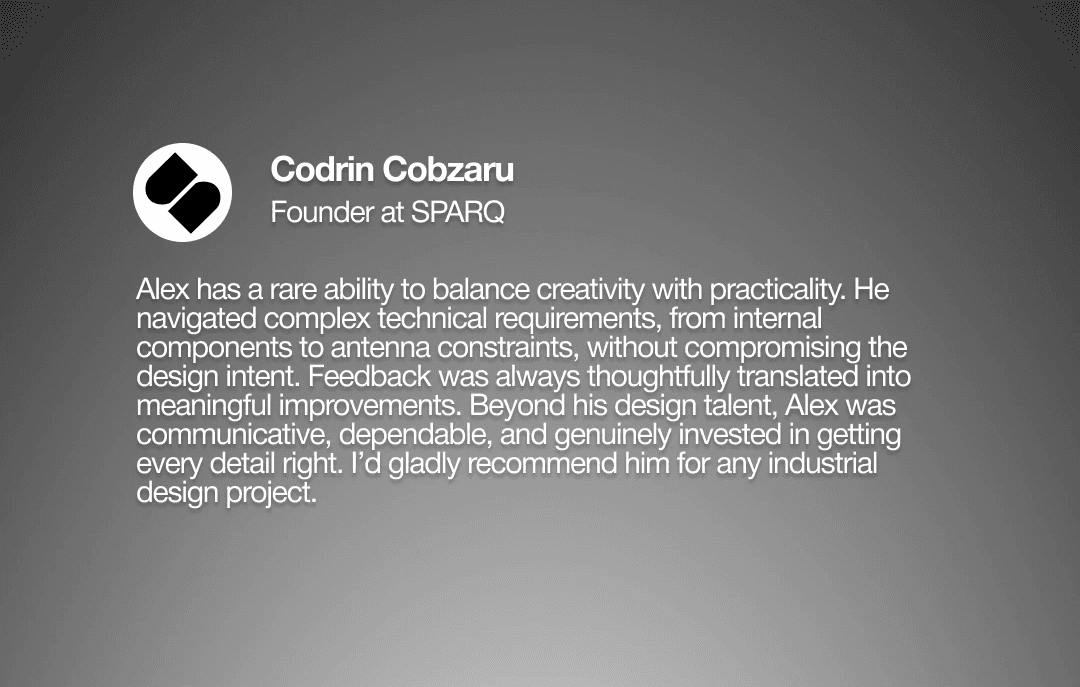
Testimonial


FAQ
( 01 )
Do you handle production, or just design?
( 02 )
What if I need changes after a phase is approved?
( 03 )
How do you handle communication throughout the project?
( 04 )
Can I use the files with any manufacturer or engineering team?
( 05 )